Author: Mythos team
Use Voltway to explain real services, show credible work, and give customers a contact path you have checked from the published site.
Start with the customer's decision
A service website should let someone determine whether you do the work they need, serve their location or type of customer, and offer a suitable way to inquire. Start with those decisions rather than a list of fashionable sections.
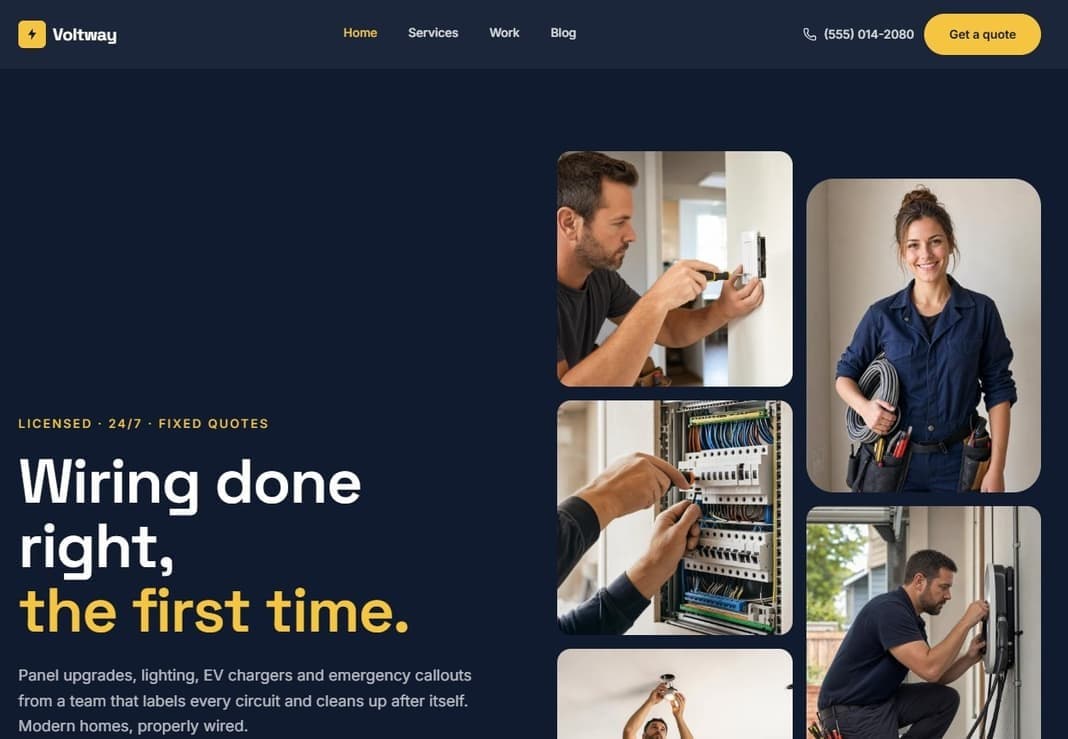
Voltway is a trade-services starting point with a navy and amber design. It includes home, services, portfolio, blog, article, and quote pages. Its sample identity and claims belong to a demonstration, and its quote form does not deliver an inquiry to a business.
Use the structure if you need several service descriptions and examples of completed work. Keep the blog only if you have useful articles to maintain. For a freelancer selling one narrow service, a shorter site may be sufficient.
Open Preview, map the pages to your business, and review current pricing before a Remix or Build. The screenshot above shows the template you will adapt, not a verified customer project or a promise of incoming leads.
Collect the facts customers need
Write one source brief that can also be reviewed by the business owner. For a studio building on behalf of a client, have the client confirm it before publication.
| Information | What to supply |
|---|---|
| Identity | Actual trading name and a publishable logo |
| Services | Work offered, deliverables, and important exclusions |
| Coverage | Real service area or remote-work availability |
| Availability | Business hours and a response expectation you can meet |
| Contact | Monitored phone, email, or an existing booking destination |
| Evidence | Approved project photographs and accurate descriptions |
| Credentials | Only current qualifications, memberships, or licenses you may claim |
| Pricing | Verified prices, a clear quote process, or no price claim |
Replace every sample rating, job count, year of experience, and licensing statement. Do not turn a template's demonstration numbers into claims about your business. If you cannot verify a statement, omit it.
For each project image, explain the work performed and your role. Avoid publishing customer addresses, faces, or identifying details without permission. An accurate description of one relevant job is more useful than a gallery of unrelated stock images.
Give AI a complete service brief
Use Voltway's Remix action and provide the business facts, approved images, and contact destinations. Keep the first request focused on presenting the business. The prompt below uses direct contact links until a quote form has a real destination.
Adapt Voltway for [business name], offering [services] to [customers]
in [actual service area / remote market]. Write the site in [language].

Use these confirmed business facts: [brief].
Replace all sample names, ratings, statistics, licensing claims,
contact details, and project content. Do not invent missing proof.

Home: explain the main service and the next step.
Services: explain scope, exclusions, and how to request a quote.
Portfolio: use [approved projects and images].
Blog: [use supplied articles / remove unused pages and navigation].
Contact: link to [monitored email], [phone], or [real booking page].

Replace the simulated quote form with these real contact options.
Do not show "request sent" when no message has been delivered.
Keep the existing visual structure and make contact details, navigation,
and long service names usable on mobile.
Review each service page independently. Someone arriving directly from a search result should understand the offer without first reading the homepage. Ask for a focused follow-up when one page needs more context.
Make an inquiry reach a real person
Voltway's original form validates input and simulates submission. It does not send a quote request. Treat that as a content and interaction demonstration until an actual delivery path is connected and tested.
A direct phone link, visible email address, or established booking page can be a practical first contact method. Test the recipient or number and verify opening hours. A mailto button opens an email application; the visitor still needs to send the email. Keep the address visible for people who prefer to copy it.
If you add a quote form later, define the recipient, required fields, expected response, and failure message. Test one valid request with details you control and check that it reaches the intended inbox or system. Then test invalid input and a delivery failure. Do not display success just because fields passed validation.
Collect only information needed to answer the inquiry. Explain how submitted details are used, and keep sensitive documents out of an initial public form unless your process genuinely requires them.
Review the site as a customer on a phone
Check whether a customer can answer “do they do this job?” and reach a contact option without decoding the design. Use your longest service name and a realistic amount of text rather than ideal short placeholders.
- Open each service and project directly, then return through the navigation.
- Read contact details, service coverage, and hours at mobile width.
- Check that phone and email links use the correct destination.
- Verify headings, image crops, contrast, and keyboard focus.
- Remove sample reviews, badges, map locations, project figures, and article authors.
- Confirm that the quote page describes the contact method that is actually available.
For a local business, use accurate place names in relevant sentences. Do not create near-identical pages for every nearby town with no distinct information. For remote services, explain the actual collaboration process instead of implying a local office that does not exist.
Ask someone unfamiliar with the business to find one service and explain how they would request it. Confusion in that exercise identifies a concrete edit.
Publish with a clear owner for inquiries
Give each substantive page a title and description that match its content. Include the business name and the specific service where useful, without repeating the same list of keywords everywhere. Check the sharing image, language, and public contact details.
After Publish, open the public website in a signed-out browser. Visit a service page directly, refresh it, inspect the quote page, and complete the chosen contact path. A preview review does not replace checking the published destination. Remove private notes and any remaining sample content before sending the address to customers.
For client work, hand over the published URL, who maintains the content, who receives inquiries, and which external service handles bookings or forms. Do not promise response times the client has not agreed to meet. A working website still needs someone to answer and maintain it.
Open Voltway and prepare the business brief before requesting changes. If your strongest evidence is a personal body of work, the portfolio guide provides a better starting structure.