Author: Mythos team
Turn Cadence into a focused landing page with one clear offer, credible sample content, and an honest path from interest to the next action.
Choose one action before editing the page
A landing page should help one audience decide whether to take one next step. Write that step first: read a sample issue, visit a real signup page, or contact you about a service. A mixture of unrelated actions makes both the content and the result harder to evaluate.
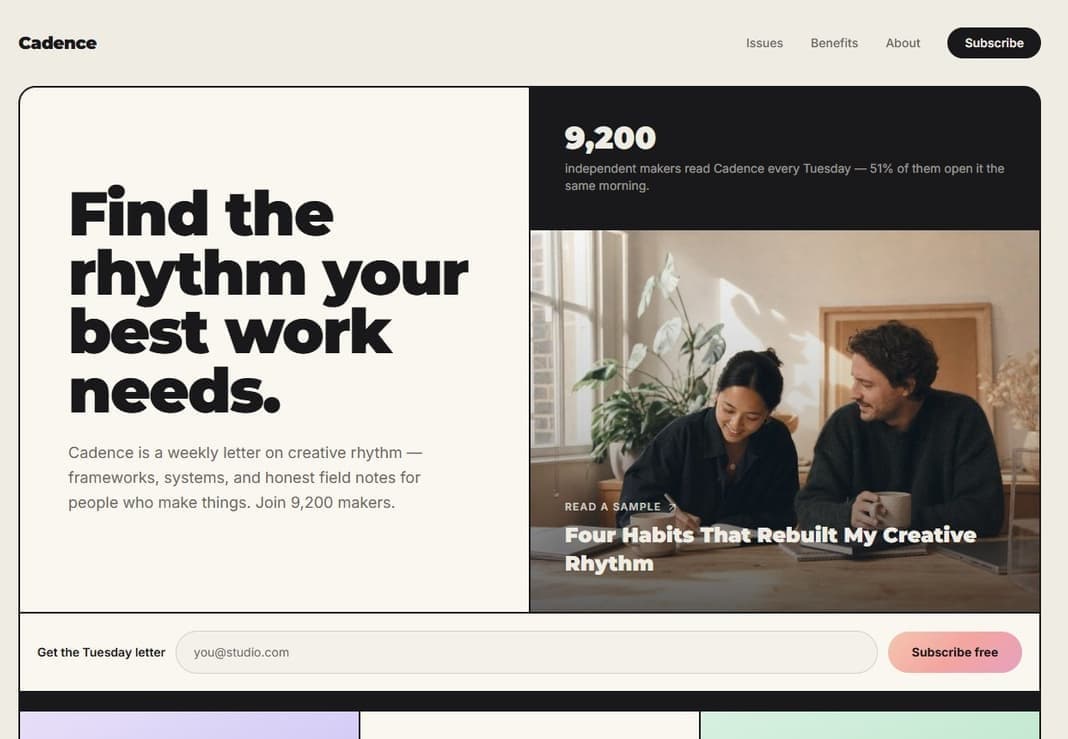
Cadence starts as a newsletter landing page with a bento layout, author and benefit sections, a sample issue, and a subscription interface. It is a useful starting point for an editorial offer because visitors can inspect the kind of content they would receive. The cover shows the existing template.
The subscription interface is a demonstration: its confirmation does not prove that an email address was stored or subscribed. Decide whether your first public version will link to an existing signup service or include a separately connected and tested form. Check current pricing before starting a Remix or requesting AI changes.
Supply an offer a reader can evaluate
Prepare a short content pack before changing the design. It should explain who the page is for, what they receive, why it is useful, and what happens after the main action. For a newsletter, include its actual subject, frequency, author, sample issue, and signup destination.
Be specific about benefits. “One practical teardown of a freelance website each month” is easier to understand than “insights that transform your business.” Use your real format and schedule; the example is a writing pattern, not a claim about your offer.
Supply these assets and decisions:
- One headline and a sentence explaining the offer.
- Three distinct benefits supported by the actual content.
- An author introduction and an image you can publish.
- A complete sample or an accessible link to it.
- The main button label and its real destination.
- Any subscription terms and privacy information that apply.
Remove the template's sample reader counts and testimonials unless you can replace them with accurate, permitted statements. Empty social proof is better omitted than filled with invented praise.
Describe the content change and the signup boundary
Use the Remix action on Cadence's template page. Replace the bracketed values in this prompt, then provide the complete sample article and any approved images. This version assumes you already have a functioning signup page; if you do not, choose a contact or sample-reading action until subscription is ready.
Adapt Cadence for [newsletter or editorial offer] aimed at [audience].
Use [language] for the page. Keep the bento composition and readable
article layout, but replace all sample identity and editorial content.

Headline: [text]. Description: [text].
Benefits: [three concrete benefits]. Author: [approved biography].
Sample issue: [title and complete text or a real destination].

Main action: "[button label]" linking to [working signup URL].
Remove the simulated email-subscription form and any confirmation
that suggests this website has stored a subscriber.
Remove sample reader counts and testimonials; use only supplied proof.
Keep legal and navigation links only when they lead to real content.

Make headings, cards, and the main action work on mobile. Preserve
the relationship between the landing page and the sample issue.
Review content before adding decorative effects. If the page promises a particular type of issue, the sample must demonstrate it. A visual change cannot resolve an unclear offer or a missing signup destination.
Verify what happens after the button
Cadence includes input validation and a simulated thank-you flow. That is useful for demonstrating a layout, but it is not a mailing-list integration. A visible “thank you” message is not evidence that a subscription exists.
For the smallest working version, link to a signup page you already operate and test that destination. Use an address you control, complete any required confirmation, and check the subscriber record in the mailing service. Make the button describe the next step accurately; “View a sample” and “Subscribe” should not lead to the same unrelated page.
If you later add a form on your own site, verify validation, consent where applicable, delivery to the intended service, duplicate submissions, errors, and the confirmation message. Never show success when the service rejected the request. Until that path works, keep the real external destination or remove signup from the public page.
Also verify unsubscribe and privacy information in the system that actually manages subscribers. A template's legal page cannot describe a different business automatically.
Check the landing page and sample together
Review the full reading journey on a narrow screen: understand the offer, inspect the sample, return, and take the next step. The sample article matters as much as the hero because it provides the evidence for the promise.
Check that bento cards appear in a sensible order when stacked. A headline must not depend on an adjacent card to become understandable. Verify that long titles wrap cleanly, body copy is readable, and the main action remains recognizable after scrolling.
Navigate with a keyboard, inspect focus indicators, and confirm that buttons have meaningful labels. Test every navigation, sample, signup, and legal link. If a link opens another service, ensure the visitor reaches the intended offer rather than that service's homepage.
Use real article images sparingly and compress them for their displayed size. Do not put essential benefits or signup instructions only inside an image. The page should remain understandable while images load or when someone reads it with assistive technology.
Publish a complete offer and improve it with evidence
Set a descriptive page title, a short description, and a sharing image that matches the offer. Remove unused sample pages, placeholder identities, and links that return 404. Publish the reviewed version, then open the public address while signed out and repeat the landing-to-sample-to-signup journey.
Record what you actually want to learn: whether relevant visitors understand the offer and complete the intended action. If your existing signup service reports confirmed subscribers, use that outcome rather than counting a button click as a subscription. Without source information, do not attribute every new subscriber to this page.
Make one meaningful revision at a time: clarify the audience, improve the sample, or change a misleading button label. A small amount of traffic does not support confident conversion claims, and no template can promise a particular search position or subscriber count.
Open Cadence to review its starting layout. For a site that needs service descriptions and quote inquiries, follow the service-business website guide.