
Farline Travel Blog
Blog website template
Create a travel blog with Farline. Square photography, full article pages, an author introduction, newsletter signup and contact forms, ready to edit in Mythos.
by Mythos·0 remixes
Key Highlights
A photographic journal
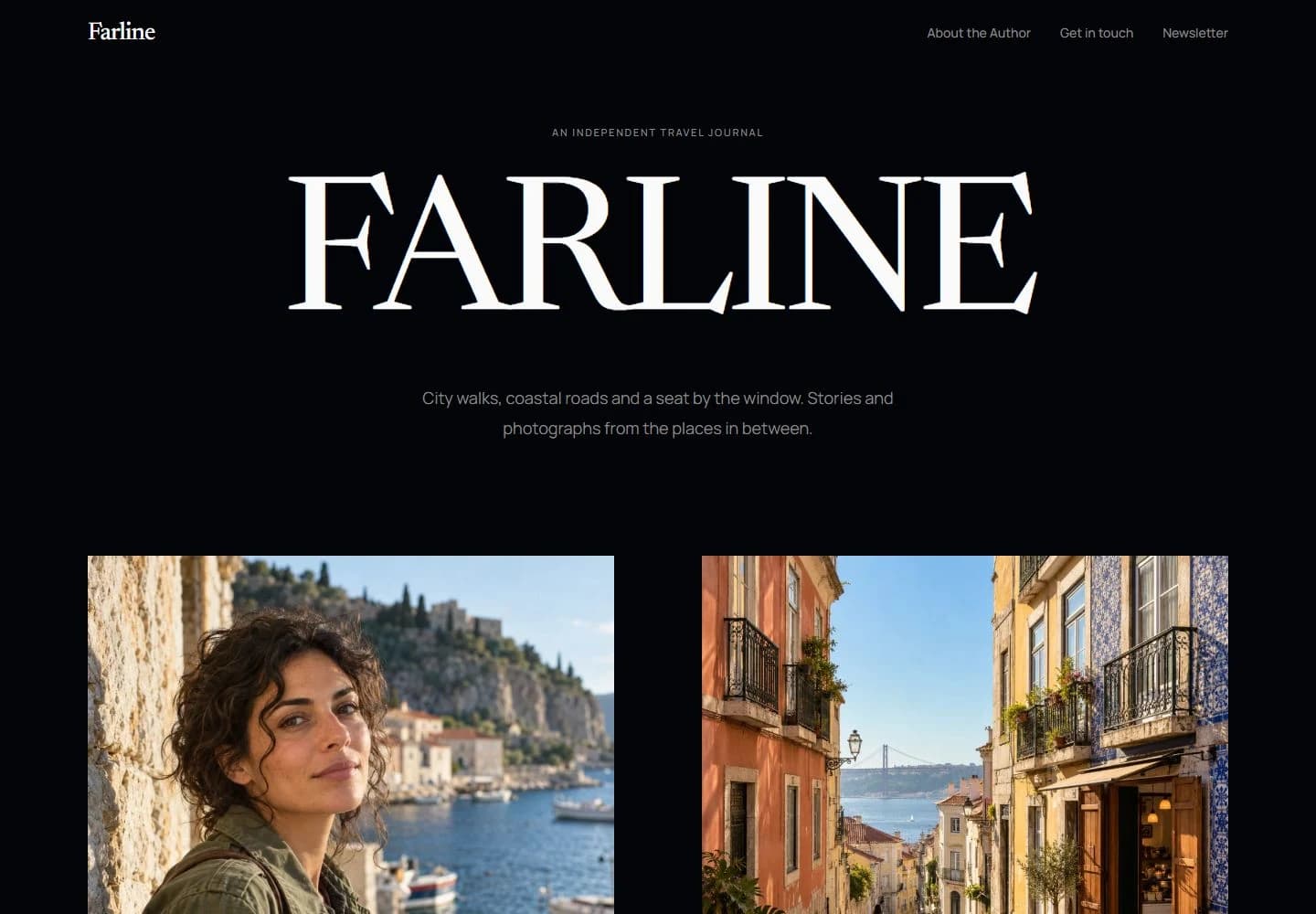
Square story covers and a large masthead give the homepage its editorial character.
Nine complete travel articles
Dedicated reading pages include an author, publication and update dates, sharing and a related story.
An introduction to the author
Replace the sample biography and photographs with the people and places behind your publication.
Comfortable reading on smaller screens
A single-column mobile layout, local fonts and responsive images adapt the journal to the available space.
Newsletter and contact forms
Collect addresses and messages in your own Supabase database. Email delivery is configured separately.
Individual page metadata
Static HTML, article structured data and social previews, with canonical URLs and a sitemap for your domain.
Features & Capabilities
Explore the pages, interactions, and starting content included in this template.
About this template
Farline is a travel blog template for writers and photographers publishing city notes, journeys and photo essays. A large Newsreader masthead opens into a grid of square photographs. The dark background and Manrope body text carry through to the article pages, with a narrow reading column and a full-width photograph inside the article container.
Nine original sample travel articles and a fictional author introduction give you a complete journal to explore and make your own.
Who it suits
Independent travel writers can build a recognisable home for destination stories, personal essays and practical field notes.
Travel photographers can give individual images room to breathe, then connect them to the story behind the frame.
Slow-travel publications can present thoughtful routes, neighbourhood guides and observations without turning every page into a crowded itinerary.
Small editorial teams can start with a coherent journal and adapt the author details, article collection and contact page around their own voice.
A complete reading experience
The homepage uses two spacious columns on larger screens and a single column on phones. Each card links to a dedicated story with a publication date, author byline, square cover photograph and generous reading width. A related story gives readers somewhere useful to go next.
The author page introduces the person behind the journal. Get in Touch includes a contact form and expandable answers to common questions. A newsletter drawer is available from the desktop navigation and mobile menu. Keyboard focus, Escape dismissal and reduced-motion preferences are supported.
Article sharing uses the current story address, with a copy-link button and external sharing links. A designed missing-page screen helps readers return to the journal when a URL is unavailable.
Make it your own
- Remix Farline in Mythos. Open the working journal and browse its pages before editing.
- Set your identity. Replace the name, author biography, dates, privacy notice and introduction with details that describe your publication.
- Publish your stories. Edit the article text and replace the sample photography with images you own or are licensed to use.
- Connect your forms. Use your own Supabase project and the included initial database migration to store newsletter subscriptions and contact messages.
- Prepare your domain. Configure the final website address, review the metadata and enable indexing when the journal is ready.
Forms and publication
Both forms validate their inputs and report success only after the connected database accepts the submission. Duplicate newsletter addresses do not create another subscriber. Public visitors cannot read the lists of subscribers or messages. The unconnected demo disables the form controls and shows an availability notice before visitors enter their details; sending newsletters or contact email notifications requires the service you choose.
The build creates readable HTML for home, the author introduction, nine travel articles, contact and privacy pages, plus a separate 404 document. Articles include individual titles, descriptions, social previews and BlogPosting structured data. Set your public domain and enable indexing to generate canonical links and a sitemap.
Farline uses the current Mythos generation starter with React, TypeScript, Vite and Tailwind CSS. Ten original AI-generated sample photographs have responsive WebP versions, explicit dimensions and descriptive alt text. The editable content and settings live in typed source files, with no separate content-management subscription required.
Read how to start a travel blog for help with editorial planning, photography and launch.
Related Templates
Loading related templates…

